
An A to Z of the Chiswick House Archives: Y is for Yew tree
Y is for Yew tree (Taxus baccata)
In our A to Z of the Chiswick House archives, volunteer archivist Cluny Wells has been exploring some of the fascinating history hidden within Chiswick House & Gardens.
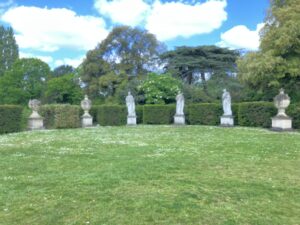
The Grounds of Chiswick House contain 130 European/Common Yew trees (just over 8% of the total of 1600 trees) and many metres of Yew hedging. The hedging was originally planted in Lord Burlington’s time to show the boundaries of his land (his English Landscape Gardens) and to accentuate various historical features such as the Exedra, acting as a backdrop to the classical statues placed there. The hedges were replanted in the time of the big restoration of 2010. Tree or hedging bush are the same plant just treated differently.
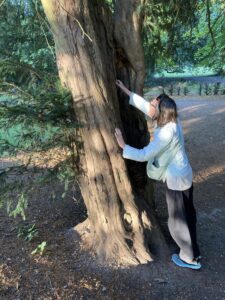
Some of the oldest Yew trees are near the cricket pitch, in the land previously part of Sutton Court, and so may have been well established before becoming part of Burlington’s land. One or two of the trees have started hollowing out and it is quite hard to accurately date the age of the tree once this has happened. Unlike many other trees, as Yews get older their girth does not necessarily expand. None of the Chiswick Yews have been recorded as ancient or veteran trees (400 to 900 years of age).
Some Yew facts:
Fossils of the European yew were first formed 15 million years ago
It is believed that Yew trees can live for up to 5000 years. They are sometimes known as ’Immortal’ – they do not need to die. As well as having the ability to grow new branches from the inside (of a hollow trunk) when the heartwood has decayed they can also lower new branches to the ground and have them grow horizontally, and lay down new roots. These stabilise the original tree and cause young healthy clones to grow, and this process has given rise to the term ‘walking trees’, as the new branches can keep moving further from the original.
The Common or European Yew is an evergreen softwood, and can grow to between 10-20 metres in height. The bark of the yew is reddish brown in colour, and this peels off with age. It is dioecious, meaning there are separate male and female plants. Both sexes have seeds or cones – the male cones produce clouds of pollen in early Spring, and seeds called arils grow from the female cones. On occasion parts of a tree can change sex, although this would usually be a single branch which does this. One of the most famous yews The Fortinghall (in Perthshire, Scotland) a male example which is believed to be the oldest yew in the UK, also has one female branch producing berries.
At the same time as Lord Burlington was planting yew hedges around his gardens at Chiswick, a yew hedge was being planted in Bathurst Estate, Gloucestershire, a hedge which today is probably the tallest yew hedge in the world, standing at 12 metres in height.
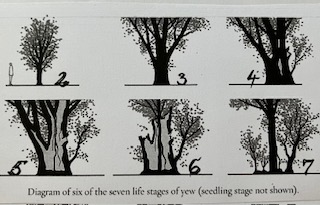
It is relatively hard to decide the age of a yew tree as, unlike with most other tree species, using the idea of size of tree and relating it to the age of the tree, i.e. the largest tree would be the oldest tree is not always applicable with the Yew. This species also has more complicated growth rhythms than other tree species – it seems to have 7 life stages compared to 3 life stages of most other trees. In the following diagram: stage 2 is the juvenile. This tree has a fast growth rate, and slim annual rings; stage 3 is the full size solid tree. The tree is in its prime and its core is intact. Then follows stage 4 the hollowing stage. The core rot begins inside the trunk, but the trunk and crown stay functional for a long time; the tree then follows as the hollow tree at stage 5; stage 6 the shell, until finally the tree reaches its last stage – stage 7 the ring. In the last stage vertical fragments of the old shell may look like independent trees or continue to share the same root system and so still be one tree.
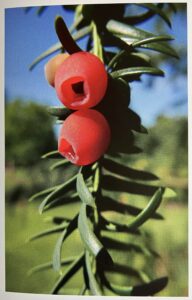
Birds and some animals i.e. badgers and grey squirrels, can swallow the flesh of the arils, the fleshy cupped female fruits and the seeds pass through them. The discarded seeds are dispersed widely to areas where they have more room to germinate. Exceptionally the wild green ring-necked parakeets, living now in South East England, and previously native to India, can eat the seeds of the yew fruits and discard the flesh.
Beliefs about Yews in the past
Druids believed that yew branches could banish evil spirits, bringing peace to those around. In Medieval times yew staves carved with relevant texts were used to perform magic tasks, and wells which were under or beside yew trees were thought to contain water with magical healing powers. The Yew was seen as a symbol of death and resurrection in both the Celtic and Christian cultures. Because of the Yew’s mystical powers it has played a part in literature. In Shakespeare’s Macbeth the 3 witches concocted a poisonous potion containing yew leaves. Tennyson’s poem In Memoriam-2 portrays the Yew as having the power of death.
Uses of Yew Wood
Yew is among the hardest of all softwoods. It is also very flexible and very strong, with a tight straight grain. It was suited to wood turning and furniture making, particularly related to high quality veneers for cabinet makers, and musical instruments such as lutes. One of the best known uses for yew wood was making long bows for the English army. It is believed to have been the decisive weapon for England in winning the Battle of Agincourt within the 100 years war with the French. Another creative use for the growing Yews was the art of Topiary, particularly popular in England in the17th century. Long before that time in 77ce Pliny described Yew topiary in Roman gardens.
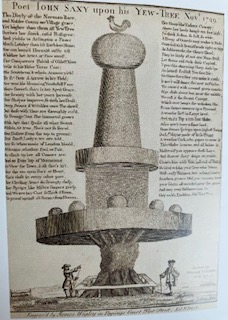
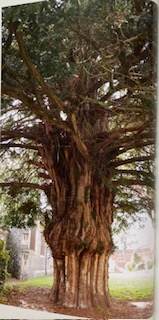
Although mainly poisonous, Yew trees – the Pacific ones, have been used to successfully treat some types of cancer using a natural compound found in their bark in the 1960s. Another anti cancer drug had been made with the needles of the European Yew. The drug produced is known as Taxol, and luckily for the ongoing existence of the Yew population a synthetic form was invented by the 1990s.
The Future of Chiswick Yews
While yew trees are found across northern, southern Europe and parts of Africa, they are happiest in some shade, with high moisture levels.
The Chiswick yew hedges, many of which were planted as part of the big restoration project in 2010, have struggled during recent long spells of drought, especially after summer 2022.
Rosie, Head of Gardens, explains:
Our tree advisors believe that the weakening of the yew trees (being managed as hedges) during this dry, hot weather has led them to be more susceptible to disease, especially phytophra (root rot) a fungal disease that easily spreads and can remain in soil for a number of years. We have lost several small trees to this disease. Our approach has been to replace failed specimens with self-sown alternatives and where possible, encourage any gaps in hedges to be relieved by the horizontal growth of healthy plants. The challenge for the garden team is to look after these plants and enable them to thrive, resisting the disease that is still likely to be present in the soil.
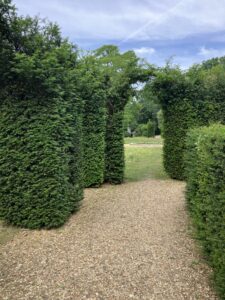
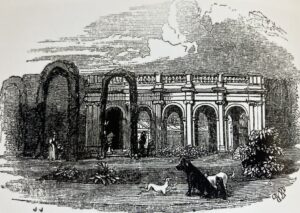
One of the recent projects in the last year for the gardening team is training the yew hedging to mimic the arched shapes of the 19th century Arcade.
Notable Yews in History
The Ashbrittle Yew– 3,000 to 4,000 years old. Somerset, England. Male
The Fortinghall Yew – said to have been between 3,000 & 9,000 years old, but now is estimated to be between 2,000 and 3,000 years of age. Perthshire, Scotland. Male
Sources:
Books
- “The Immortal Yew.” Tony Hall.
- “Yew.” Fred Hageneder.
- “Chiswick House Gardens.” David Jacques.
- “The History Trees.” Colin Salter.
- “Palladian Revival.” John Harris
Television
- TV ch5 programme ‘The magic of trees’ has a section on Yews.
