
Archives Episode
1a. Mind the Carriage!
Narrator:
We begin with Mind the Carriage by Robin Brooks, a writer of radio plays for BBC Radio 4 who lives in Suffolk.
Jacques Rigaud:
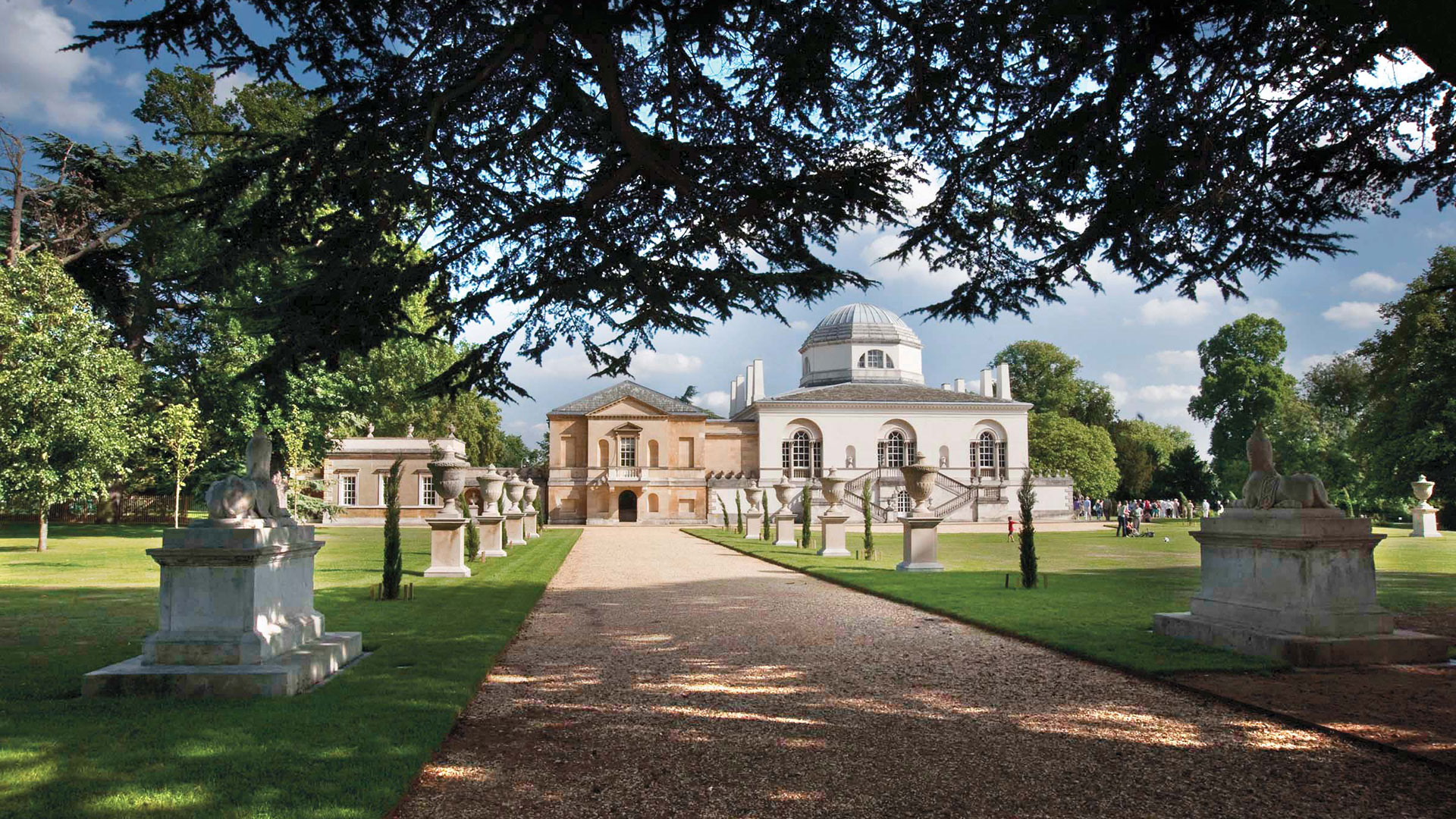
(Drawing a picture) Can you see what it is yet? I’ve got the new house, dead centre. Lovely columns, pediment, Palladian front, dome worthy of the Eternal City itself, very nice. I’m putting in the old house to the side, the right-hand side there. I’m making it smaller than the new house, which it isn’t, but that’s a little bit of artistic license on my part – Lord Burlington wants a drawing of his new house, not his old one, so keep the old one in the background…
I’m putting in lots of people. A couple on the left, down at the front, under the trees. There’s some sort of assignation going on there. Leave it to you to guess what’s going on. What shall I do on the other side? Put in a cow… Hmm… To be honest I’m happier drawing buildings than cows. Sometimes my cows turn out like horses, sometimes like large dogs. Tell you what, I’m going to put myself in, standing under a tree, looking at the cow and wondering how to draw him properly.
Now, I’m putting three chaps leaning on the gate looking at the new house, and one of them’s got his arm out, waving it at the house. You can hear what he’s saying just from the angle of that arm: “Oh, I say, chaps, look at this marvellous new house wot the Lord Burlington has built.” More people, just beyond them, also looking at the house. Can’t have too many people looking at the new house.
What else? A bit of smoke, coming out of the chimney, to show that his Lordship is at home, toasting his noble muffins on the fire. What else…? I know! A carriage, going in through the front entrance. Look, these important people are coming to visit, isn’t our Lordship a popular man, by goodness he is. Got to make it look busy, people coming and going, troops of friends.
One last thing, make it stand out. What…? Hmm… I’ve got it! The road! The road runs right past the front of the house. A main road! Right past the front of the house! What could be more exciting? What could be more up to date? I’ll put lots of traffic on it. Carriages, horses, carts, riders. When people see this, they’re going to think – “Golly, look at Lord Burlington’s house, right on the main road! I wish my house was on a main road!”

1b. About Chiswick House
Narrator:
Lord Burlington designed the villa we know as Chiswick House in about 1725. It’s one of the most important examples of Palladian architecture in the country, a style named after the work of 16th-century Italian architect Andreas Palladio. Palladio was inspired by the classical buildings of ancient Rome and he tried to recreate the formality and proportions of those buildings in his designs. The Palladian style was later adopted in England by the celebrated architect Inigo Jones – which explains why so many older English buildings look like Roman temples.
Lord Burlington, also known as the ‘Architect Earl’, was inspired to design his own building in the Palladian tradition here at Chiswick. The House was intended as both an architectural exercise and a residence – although most of its owners never lived inside. During the 18th century, it was fashionable for the wealthy to build retirement and holiday retreats on the banks of the Thames. Today’s house is the lone survivor of these retreats: it originally served as an annexe to an early 17th century manor house, but this was later demolished.
Like the House’s Classical style, the Gardens were also inspired by ancient Rome. Burlington wanted to create the sort of garden that would have been found there, as featured in classical mythology and literature: a mixture of greenery and water, groves and woods — all adorned with statues and highlighted by spectacular vistas.
The waterfall you see descending a series of rock steps through three archways is known as the Cascade. It was one of the later additions to Burlington’s Garden, created in about 1738 and probably designed by his friend, the designer William Kent. A hydraulic system pumped water to the top of the falls. However, the system kept failing and the Cascade remained dry until more modern technology was installed. The Cascade flows into what appears to be a ‘river’. It was originally a stream but was widened by Burlington, first into a formal canal and then into a more naturalistic lake. The terrace walk behind the cascade was formed from the earth excavated to create the lake.
2a. Chiswick as it Never Was?
Narrator:
The Shadow by Michelle Penn, a London-based poet and fiction writer.
Shadow:
(Tone: humorous jealousy)
I am only her follower, her echo, barely noticeable. She flits and she flirts with the bird in her hand and she sings, she sings, tra-la-la-waltzing her way across a patch of grass, her stage, lit just for her by a gracious sun. I do my best, follow and keep up, but she’s more graceful, more subtle than I — a mere shadow. She has even dressed for the occasion, outdone me once again, her snappy white dress and hat match the house perfectly. They even match the clouds, those perfect painter’s puffs. Or no. Of course. They dressed to look like her.
(Humorous, singing a little made-up song)
How can the river and trees even compete
when my little mistress takes to her feet?
(Speaking again)
Even her dog, what’s-his-name, even he can’t command attention the way she can. He simply barks his unbroken adulation, his anthem of love and she laughs, taps him playfully on the nose before joining a new duet with the birds. If she could, she’d take wing, her dress billowing, drawing her above the treetops and toward the clouds. I’d be clinging to her ankles, hoping not to fall.
Low and silent as I am, I try to accept my place. I try to be generous in thought and spirit, more picturesque in my own private way.
‘Just act naturally,’ she whispers. ‘Please don’t worry so.’
(More thoughtfully)
I am my mistress’s shadow. Only the trees and river don’t know, the big house doesn’t know that the little miss doesn’t exist. She’s no more solid that I. She is an artist’s whim, a flick of colour on canvas, a fine detail in a splendid scene. A happy phantom perhaps, but a phantom nonetheless. Even the prettiest landscape needs its shadows.
2b. A Revolutionary Garden
Narrator:
Chiswick was a new and revolutionary kind of garden. At the beginning of the 18th century, it was fashionable to have formal gardens, which were laid out in carefully planned geometric shapes. Lord Burlington bucked that trend, with more natural-looking stretches of water and groves, opening out into sweeping lawns which created vistas, or picturesque views. These more informal gardens gave birth to the English landscape movement and were widely copied across England, including Stourhead in Wiltshire and Stowe in Buckinghamshire.
Terraces like the one you’re now walking along weren’t particularly new in garden design, but Lord Burlington set a precedent by planting his with ‘… all manner of sweet shrubs, roses and honeysuckles.’ From this terrace, visitors had spectacular views across the meadows.
At its height the garden estate would have been more extensive than today. Part of the land was leased to the London Horticultural Society (later the Royal Horticultural Society) for an experimental garden open to the public. Today, many landmarks in Chiswick are reminders of what was once there, such as a nearby cul-de-sac known as Horticultural Place.
Many artists came to paint Chiswick, including Flemish artist Andreas Rysbrack who made a series of paintings that recorded the garden’s transformation from formal arrangement to largely informal and picturesque. It was the artist and designer William Kent who was instrumental in helping Lord Burlington realise his vision for his new garden.
3a. The Artist Admires His Handiwork
Narrator:
The Artist Admires His Handiwork, a.k.a. ‘It’s not Bill,’ by Under 18s competition winner Florence Read, aged 15.
William Kent:
I really do wish that they’d all stop calling me Bill. My name’s William for God’s sake. I just wish that they’d leave me be, stop questioning my methods. Just because I may not be as qualified as the next horticultural wizard doesn’t mean that I lack enough talent to see this project through. It’s pretty simple really, doesn’t take much of a mind to do; bit of shrubbery here, a tree or two there, the odd topiary duck, simple.
[Pause]
Or not so simple.
[Pause]
Insanity runs in my family I think, I think it runs deep in all those who create, who inspire. When you’re sane you have to care, only the truly insane can be carefree, or free at all. I have thought a lot over the past few months, while working in the gardens. In nature, there is nothing of the city to distract you; you are utterly alone with yourself and your thoughts.
[Pause]
No, not at all. [Pause] It’s laughable, once I even contemplated giving it all up and leaving someone else to finish the garden. My garden. My creation. My child… almost. [Pause]
After so much effort and time and hardship to let it all go, that would have been the true definition of madness. Luckily, I have the ability to expel these thoughts as quickly from my head as they enter it. And that was that, I had to finish. And now… and now I am finished. And it is a strange, humbling feeling. To sit in a part of the world that has come from me, from my head and my heart alone.
I’ve created my own Garden of Eden, my home for Adam and Eve. In that case does that mean that I have become Adam? Or perhaps more fittingly have I in fact become God? I have created, after all, this land. I am the creator; I have the power to create, and to destroy in equal measure. This is what scares me I think; this is why I come back night after night, so unsure of my standing. This power, this control, over so much life. It frightens me, but more, more than that. It, it makes me sad, lonely even. Nothing can ever be as perfect as I can imagine it and that’s just it, the way I imagined it can only lead to disappointment, don’t you see?
[Pause]
Tell me if I’m boring you. I don’t wish to be a bore, I’ve had to endure my fair share of those at all these stuffy, grand parties. Those are the ones who call me Bill, always Bill never William. I was born William wasn’t I? I don’t meet a man who introduces himself as Geoffrey and call him Edgar or Roger or anything. I don’t do that, I wouldn’t do that.
Do you like the arch? Beautiful isn’t it? My favourite thing in the whole grounds. Funny how my favourite thing is also one of the only things that I didn’t create here. It’s a shame really, a lovely piece of stonework. I love to watch it in the moonlight; everything in the gardens sparkle.
[Pause]
And then you dance for me. I know that you try to humour me, so that I won’t dig up your burrows. It seems to have worked so far, hasn’t it? You keep me sane I think, at the end of the day. After hours of calculation and deliberation and conversation you just put my mind at rest. You remind me what this place is for. I would dance with you tonight but my feet are tired and my back is aching. Perhaps tomorrow, or the day after that.
3b. The Obelisk, Lord Burlington and William Kent
NARRATOR:
Burlington added the Obelisk to the garden in 1732. Built into its base is a classical sculpture of a man and a woman, probably carved to record a marriage. It had been given to the young Burlington in 1712 and he had it inserted into the base of the obelisk in 1728. The sculpture was replaced with a copy in 2006, and the original is now on display in Chiswick House.
Lord Burlington was just 10 years old when he inherited his title from his father. His inheritance included a house here at Chiswick, vast estates in Yorkshire and Ireland, and a fine town mansion in Piccadilly — today the home of the Royal Academy of Arts. In 1719, on a tour of Italy, he met William Kent, where Kent was training as a painter. By 18th century standards, they were an unlikely match: a formal and reserved aristocrat and a warm, witty and irreverent Yorkshireman. But they formed a close lifelong friendship. In fact, when Kent died in 1748, he was buried in Lord Burlington’s family vault.
Kent became one of the most influential designers of the 1730s and 1740s with the support of Lord Burlington. The art historian and writer Horace Walpole said that ‘Lord Burlington became England’s ‘Apollo of the arts’ and Kent ‘his proper priest.’ However, the two men never laid out an overall plan for Chiswick. Instead, the garden changed in stages that spanned more than 20 years.
One celebrated feature of the garden was the Ionic temple, which you should see ahead. It was modelled on similar circular temples in ancient Rome and Lord Burlington designed it himself. While it wasn’t unusual for 18th century aristocratic men to be involved with architecture, Burlington was extremely unusual, going on to design substantial buildings, like the dormitory at Westminster School and the Assembly Rooms at York. His wife, Lady Burlington, was also a talented artist. William Kent taught her to paint and draw — and she might have contributed ideas for both the house and garden.
4a. The Ionic Temple
NARRATOR:
Former Poet Laureate Andrew Motion reads his poem, ‘The Ionic Temple, Chiswick.’
SIR ANDREW MOTION:
Once upon a time it was the thimble a seamstress might wear to work for the big Classical gods.
For us it more nearly resembles the domed nose
of a cruise missile easing upwards from its silo.
But enough of that.
When we step inside it fits so snugly I might as well have discovered a way
of living in your head as you now live in mine.
The skylight in the centre overhead is a fontanel yet to close.
We can stare straight back at the sun.
4b. Chiswick after Lord Burlington
NARRATOR:
After Lord Burlington died in 1753, Chiswick House was inherited by his daughter, Charlotte, who married the 4th Duke of Devonshire. The Devonshires were one of the richest and most powerful families in England. Under their ownership, which lasted for 140 years, Chiswick continued to change, with innovative designs that reflected cutting-edge trends.
In 1788, the 5th Duke expanded the house, adding two wings that contained kitchens and living accommodation and Chiswick became a proper country mansion. The sombre Duke, who preferred dogs to people, and his wife, Georgiana, made the house a centre of political society, where they threw lavish parties. Georgiana was a fashion icon, famous for her enormous ostrich feather headdresses, her towering hair-dos, and her manner of speaking, the ‘Devonshire House Drawl’. She was equally infamous for her addictions, extramarital affairs and gambling debts. However, she loved Chiswick, calling it her ‘earthly paradise,’ her refuge.
At the end of the 19th century, the house became another sort of refuge: it was let to the Tuke brothers, who opened a private asylum for wealthy individuals with mental illnesses.
5a. A Place of Healing
NARRATOR:
‘A Place of Healing’ by Adults competition winner Jo Thomas.
Constance:
Another beautiful day Lydia, and in such perfect surroundings.
Lydia:
Dearest Constance, I could not agree more. When Edmund told me the rest home was in Chiswick, I was most distressed at the thought of leaving London for the country, but I am now beginning to wonder how we shall ever get used to the noise of Belgravia again!
Constance:
I completely agree with you my dearest. And how kind of our husbands to arrange for this period of recuperation for us. Although, if I were to be completely honest, I am a little surprised I have not been recalled to Ebury Street by now. I was of the impression that our period of rest was for two weeks. Correct me if I am wrong Lydia, but I believe we have both been here for something closer to three months?
Lydia:
Dearest, that is indeed the case. And I feel sure we are now well recuperated. Which is more than one can say for some of our fellow guests. There is a clever word for people who covet the possessions of others, I cannot remember it just at this moment, but I am certain it applies to the Dowager Countess. Last night in her room, in addition to my new Mr Forster novel, the nurses found twelve soup spoons, one 18
silver tea tray, three walking canes and Dr Tuke’s pipe. I know that at fifty she is well advanced in years, but surely there are more suitable places for such women to be secured?
Constance:
And now it is my turn to agree with you, Lydia. Let us hope that the situation improves.
Lydia:
I do hope that we hear from our good friend Mrs Fawcett soon. I am confused about her silence. Indeed I am surprised that none of our friends from The National Union have contacted us. Edmund assured me he would pass on our new temporary address, so we might continue our important work from the peace and quiet of Chiswick.
Constance:
Indeed, the timing of our visit to this charming place is most unfortunate. I feel sure that given just a little more time we could have persuaded Mr Asquith to be sympathetic to our cause. I believe we made great progress at the House of Commons’ tea party. Mrs Fawcett was delighted we were able to talk to the Prime Minister directly, a much more civilised approach than that taken by dear Mrs Pankhurst and her associates.
Lydia:
I do believe that Edmund, and your beloved Henry, were surprised by the fortitude of our discussions with Mr Asquith! I saw them in deep discussion afterwards. Perhaps they will now be more vocal in their support for our activities.
Constance:
Alas, from this distant place, cut of from our sisters in the National Union and without our usual means of support, I fear we are of little value.
Lydia:
Let us not be downhearted Constance. I see the gardener and stable boy ahead. Let us ask them if the Royal Mail has been delivered to day – I am sure good news awaits!
5b. A Peaceful Asylum
NARRATOR:
The Tuke brothers ran their mental asylum here at Chiswick for more than 35 years. Rather than prescribing drugs, they listened and talked to their patients and were celebrated for their enlightened attitudes. Dr Thomas Seymour Tuke’s obituary described how his personal tact with patients led to them looking upon him as a trusted friend more than a doctor.
Most of the patients came from the upper middle class, gentry and aristocracy. Their days were mainly spent in the gardens, walking arm in arm with nurses. They also went on escorted outings to the theatre and played cricket on a pitch here at Chiswick that the Tukes laid out in the 1890s.
Cricket played a therapeutic role of sorts for patients. The doctors were keen cricketers themselves- Dr Charles Tuke played for Middlesex- and they encouraged patients to play and brought in outside teams for some healthy competition. One case note for a ‘Mr M’, who played cricket daily, reports that he ‘made a good score of 49 not out against the police’. Cricket is a sporting tradition that continues at Chiswick to this day.
6a. A Sporting Tradition
NARRATOR:
‘A Sporting Tradition’ by Chiswick Residents competition winner Nigel Macarthur.
MALE VOICE (in a comic fashion):
Our spying is top secret,
We will not give our names.
Inside the boundary, cricket.
Outside are other games.
We’re here to pass a message,
When we receive our cue.
The scores, appeals and all the rest,
Conceal a thing or two.
The match, we’re told, is choreographed,
Down to the ice creams bought.
We buy our raspberry ripples,
When the score is two for nought.
Our rivals, though, have followed.
They’re very different men.
One’s thickset, scruffy, tie askew.
He does rough stuff, as-and-when.
The other, Trevor Howard-like,
Will get the ladies chatting,
And try to find our movements,
While the openers are batting.
The pitch grows unpredictable,
Thanks to the recent rain.
Those pre-planned cues and signals,
Begin to feel the strain.
The bowler tries to slow the ball,
But it swings off the seam.
The bails are dancing through the air,
Like an aerobatic team.
We’re forced to signal much too soon.
My hands begin to shake.
The cigar falls in my ice cream,
Like a leaf-wrapped chocolate flake.
And that one was my only one!
It’s far too damp to light!
And there goes another wicket!
This surely can’t be right!
Our plans are now in chaos,
As clouds form up above,
And a thick edge bounces merrily,
Into the keeper’s glove.
I quickly drop my ice cream,
And fumble for my pipe.
A dog chews ice cream and cigar,
And then begins to gripe.
The owner’s looking daggers,
Our contact can’t be found.
The time has come to give it up.
And sneak out of the ground.
A waving red ice lolly,
Is the signal we must use,
But the ice cream queue is ten yards long,
When the freezer blows a fuse.
The wickets fall like autumn leaves,
Until the ninth is gone.
The eleventh man is indisposed,
And so the twelfth comes on.
He doesn’t know the signal,
For ‘See you here next match’.
We need an LBW,
And not some easy catch.
But it really seems it’s not our day.
The spy’s life has its blips,
And the vital LBW,
Was just caught in the slips.
Our rivals, though, are mystified.
Was it really us they saw?
But we cannot pass our message now,
So both games end a draw!
6b. The Classic Bridge and Orangery
NARRATOR:
From 1946 until 1992 the Turnham Green Cricket Club played on the pitch at weekends. Celebrity cricket matches were a regular feature in the 1940s and 50s, in which famous cricketers like Denis Compton and Colin Cowdrey took part.
As you continue along the path, you will come to an elegant stone bridge, today known as the Classic Bridge. It was built for the 5th Duke of Devonshire in 1774 and was designed by the architect James Wyatt.
During the Second World War, the gardens were hit by several German bombs. If you take a look closer at the bridge, you can still see shrapnel damage. Today, the artificial lake that the bridge spans is a haven for a wide variety of birds and bats, as well as a group of terrapins and a heron.
As you continue further along the path, you should soon see the Ionic temple again. The towering obelisk in front of it stood at the centre of a circular pool of water, which was once surrounded by orange trees. Lord Burlington liked to grow oranges and created the garden’s orangery around 1726.
7. An Audience of Oranges
NARRATOR:
‘An Audience of Oranges,’ a.k.a. ‘Critic’s Circle’ by Adult competition winner Katharine Kavanagh.
Waiting in the wings
the sweet triffids,
potted critics,
surround the scene, ready
to pass judgement.
The fidgety restlessness
that comes from fur, feather and feet
is held
in awe.
An awe-dience.
Who will be victorious
in this battle of wills
and Stillness?
For there, facing down his foes,
the lone stone owns the stage.
The rows of green,
neatly trimmed and pruned,
uniform and proper,
rustle gently in the breeze,
but maintain their composure.
'His poise is good,'
'Elegant.'
Hushed, like the slow stroke
of sleepy summer butterflies,
the tension of this Act
leaks softly through the air
with the scent of oranges.
'It can't last,'
'He has to crack,'
'All alone out there,'
'And we are many,'
'Many,'
'Many,'
'We are populous.'
The rings would close in
if they could.
'We will stand here,'
'We will watch,'
'We will wait,'
'We are many,'
'Many,'
'Many,'
'He is one.'
'Our fruit has been a theatrical fixture since the days of Seneca and his orangeries in Rome,'
'Since the celebrated Shakespeare plied the globe with his trade,'
'Succulent and sweet, we are never hard, never bitter'
'Never bitter,'
'Never ever bitter,'
But the stone is unmoved, uncaring for common wares.
There are no snarling, mauling beasts here, only time, and his own reflection.
He can bear their frosty reception,
and the chill of winter
that sees his small, shrubby censurers trooped
(and trapped)
inside for the season.
He can endure it still.
8. Goosefoot, Exedra, and Rock’n’Roll
NARRATOR:
At the end of this path is one of the key features of Chiswick’s garden, a series of radiating avenues forms known as a patte d’oie, or ‘goosefoot.’ It probably dates from 1716 and has been restored to its original appearance. Each avenue ends in an ‘eye-catcher’ – an ornamental building intended to draw the eye to the end of each vista. Today, you can see a rustic house and a Doric column, although only the rustic house is original from Burlington’s time.
The large lawn behind Chiswick House is closed at one end by a dramatic semi-circular hedge known as the exedra. Here, you can see a recreation of Burlington’s collection of 18th-century sculpture, including copies of antique figures said to be the ancient Roman figures of Caesar, Pompey and Cicero. They were brought back from Rome by Lord Burlington and the originals are now inside the House. The statues of the lion and lioness, completed about 1733, were probably sculpted by Flemish sculptor Pieter Scheemakers.
This area of the garden also features Cedar of Lebanon trees, planted nearly three hundred years ago. Lord Burlington was amongst the first aristocrats to introduce this type of tree to an English garden. The trees alternate with stone urns, which have played their small part in the history of pop music: in 1966, they were the backdrop to promotional videos for The Beatles’ singles, ‘Paperback Writer’ and ‘Rain.’ You can see pictures of their video shoot on display panels in the conservatory.
Throughout their history, the gardens at Chiswick have been a magnet for the rich and famous. In 1811, the 6th Duke of Devonshire inherited the house. Known as ‘The Bachelor Duke,’ he laid on lavish entertainments, attended by many distinguished visitors, including Queen Victoria and Prince Albert, who visited in 1842. Part of the guests’ amusement probably came from the Duke’s large collection of exotic animals he kept here.
9a. Long-Necked Visitors
NARRATOR:
‘Long Necked Visitors’ by Under 18s competition winner Lily Hewitt, aged 17.
Herald:
And to welcome the Tsar of Russia to Chiswick Gardens, we have for the audience’s pleasure, four giraffes on show originally from the distant land of Africa.
Giraffe:
They say I’m from Africa, but I don’t remember it now. I was just a calf when I was shipped over, rammed tight into the crates so we didn’t fall over in the storms that brewed, turning the sky into a bruised blue. I remember the colours of Africa though; the yellow brown of baked sand under the scorching sun, the green of leaves as I strained up to reach them. The sky here is grey and fat droplets of rain fall year round.
I was brought from Surrey Zoo. They say that I’m long-necked, but look at them! The women crane their heads to stare while the children poke fingers against my leathery skin. As I look around at the pink blossom trees and frothy, brown evergreens it makes me smile because doesn’t every creature look for something bigger? The animal looks at the wilderness of the plains, the boys in their breeches tip their heads up to stare at me and I nod up to the same sky that I saw as a calf. The tsar impulsively walks over to me slowly, edging his way as though he is slightly afraid of my broadness. He stretches a hand towards me like they do in the zoo and I lean my endless neck slowly down and rub my soft cheek against his tiny hand, remembering just for a moment the soft embrace of my mother. The crowd roar; the ladies squealing and waving their pressed white handkerchiefs. The Duke of Devonshire laughs and laughs, calling to the Tsar; ‘He acts just like a little kitten, doesn’t he?’
In the distance I see the other animals in their enclosures, the kangaroos that are punching each other are being impersonated by little children. The llama ambles around, his thick fur suited to the damp English weather. He has a neck like mine, though not as tall. The elephant sees me looking and raises his trunk; another immense beast from the plains. A man from the newspaper is sketching me and I pose in front of the beautiful flowers for him. The Duke calls that ‘tea is served’ and the milling crowd has a purpose as they devour the rows of sherbets and jellies and towering iced cakes the size of wagon wheels.
A tiny little girl is shoved forward towards me by older playmates and she shyly unwraps her fingers and offers me her slice of cake. I hesitate for a moment, then sink to my knees and take it from her. My rubbery tongue licks her palm and she giggles. ‘Do you miss your home?’ she whispers quietly to me. I look around, at the acres of green grass in Chiswick Gardens, at the grey sky and the other giraffes and the fascinated humans. I nuzzle her hand and wonder if she understands my answer. As the inevitable rain begins, I stick out my tongue once again and let the droplets fall onto it. My home is here now.
9b. The Duke and his Menagerie
NARRATOR:
The 6th Duke of Devonshire owned a large collection of exotic animals, among them an Indian bull, a Neapolitan pig, and a Peruvian llama. One of the star attractions was Saidi, an Indian elephant, whose tricks included using her trunk to sweep with a broom and to uncork a bottle. She also gave rides around the lawn. She was buried in the grounds in 1829, although her bones have not yet been found.
The Duke may have collected animals to keep him company as despite being a very eligible bachelor, he never married.
The Bachelor Duke also built the conservatory here at Chiswick, which housed his collection of camellias from the 1820s. The conservatory has now been restored and it still contains a world-famous collection of camellias.
As you cross the lawn, you will soon approach another original feature of Lord Burlington’s garden: the Inigo Jones gateway.
10a. A Prize for the Architect Earl
This poem, ‘HERACLES’, is by Poet Laureate Carol Ann Duffy.
To look at him now, who would think
he’d flayed a pelt of iron, bronze, stone
from a lion,
hacked its head for a helmet...
held the Hydra’s hissing heads
by eight throats;
scarfed the Golden Hind about his own;
chained, tamed, shouldered a wild boar?
Or believe he, old man,
had harnessed rivers;
emptied the air of murderous birds,
their brazen feathers;
felt the mad, hot bull swoon in his arms;
set four crazed mares
to pulling his chariot;
wooed an Amazon simply to break her heart?
Who’d credit his arrow killed
the dragon and giant,
or bet he stole the golden apples from a god,
called to heel Hell’s dog
for the last of his labours?
But he is the Gatekeeper;
this the home of the Gods,
who plucked him, favoured,
from the wood and fire of his funeral pyre
to place him here...
and he will never let you pass.
10b. Inigo Jones Gateway
NARRATOR:
The gateway was designed by the celebrated architect Inigo Jones for Beaufort House in Chelsea in 1621. Lord Burlington admired Jones’s design and acquired the gateway in 1738 when his friend Hans Sloane was demolishing the house.
A poem by William Kent describes how the gateway came to Chiswick:
Ho! Gate, how came ye here?
I came fro’ Chelsea the last yere
Inigo Jones there put me together
Then was I dropping by wind and weather
Sir Hannes Sloane
Let me alone
But Burlington brought me hither
This architecton-ical
Gate Inigo Jon-ical
Was late Hans Slon-ical
And now Burlington-ical
Around 200 years after the gate had been installed, Chiswick became a public park. The mental asylum that the Tukes ran here closed in 1929 and the grounds and house were bought by Chiswick and Brentford Council. That same year, His Royal Highness Prince George officially opened the site to the public to be enjoyed by locals and visitors alike for relaxation and leisure.
11. Parklife
NARRATOR:
‘Parklife’ by Leah Kharibian, an audio script-writer and occasional film-maker who lives in Leicestershire.
Ted
Musing to himself
Don’t know why they gave him a bike for his birthday – pointless really. He’s sat on it once this morning, and that was just to ring the bell. I told them, ‘All the lad needs is a football – an honest-to-goodness football and a bit of grass to play on, that’s all a boy his age ever needs.’ And look at him, happy as Larry.
Out loud, to the boy, encouraging
That’s it, Johnny, don’t take your eyes off it! Remember you’re the hawk and that ball’s the rabbit!
Haynes
To himself, sniffing for scents
Rabbit, rabbit, rabbit. Hruff, squirrel? Squirrel? [Sniffs again] Rabbit. Hruff, young rabbit. [Sighs] Old dog. Old dog, old paws. Sore paws.
Ted
To the dog
Come on Haynes old boy, move it along. You’re feeling your age, aren’t you? You and me both.
To himself
And losing the cup didn’t help. Sucked all the life out the summer. [Brighter] But another season, another chance, that’s the way to look at it. And you can’t fault a morning like this. Lovely. [Pauses] That boy could do with a proper pair of shorts. Towelling’s alright for toddlers,
but … Christmas – that’s what I’ll get him. A proper Fulham FC black and white. To go with his ball.
Johnny
To himself
And Lockie has the ball! And he’s past fat old Tommy Taylor, he’s past mean old Trevor Brookin’, the West Ham goalie goes splat and Lockie scores!!! Fulham win the cup! [Starts singing to himself to the old football chant of ‘We are the Champions’] Johnny’s the Champion, Johnny’s the Champion, Johnny Lockie’s the Champion…
Ted
To Johnny. Impressed
Hey that was a good kick! Show us again. That’s it, square up. Right, now this one’s a penalty from the edge of the six-yard box. Just four minutes to final whistle – so it’s now or never. Deep breath and give it a good run up … and hammer it into the net!
Johnny
Thrilled
Look Granddad! It went miles!
Ted
Delighted. Clapping
Good man, Johnny Lockie! Great ball! See that Haynes, old boy? Going to chase after it?
Haynes
Not going anywhere
Warm sun on sore paws. Warm sun. Last warm sun.
Johnny
Excited, running off to fetch the ball
Again, Granddad! You can do the talking and Haynes can watch.
Johnny’s the champion! Johnny’s the champion! Johnny’s the champion!
Ted
Close to, as Johnny moves into the distance, gives Haynes a pat
Stuff their bike, eh, old fellow? Look like our ball’s got the morning sorted.
